
Gum disease and Alzheimer’s risk are connected through a biological pathway that researchers have been mapping for several years, with recent studies strengthening the case that chronic oral inflammation may accelerate cognitive decline. Understanding this link could change how you think about your next dental visit.
This guide focuses specifically on the emerging science linking periodontal disease to Alzheimer’s, what it means for adults in Carlsbad and surrounding communities, and what you can do about it right now.
Gum Disease and Brain Health Definition: Gum disease (periodontitis) is a chronic bacterial infection of the tissues supporting your teeth that, according to recent research, may contribute to Alzheimer’s disease through bacterial migration, systemic inflammation, and immune system disruption.
What the Latest Research Actually Shows
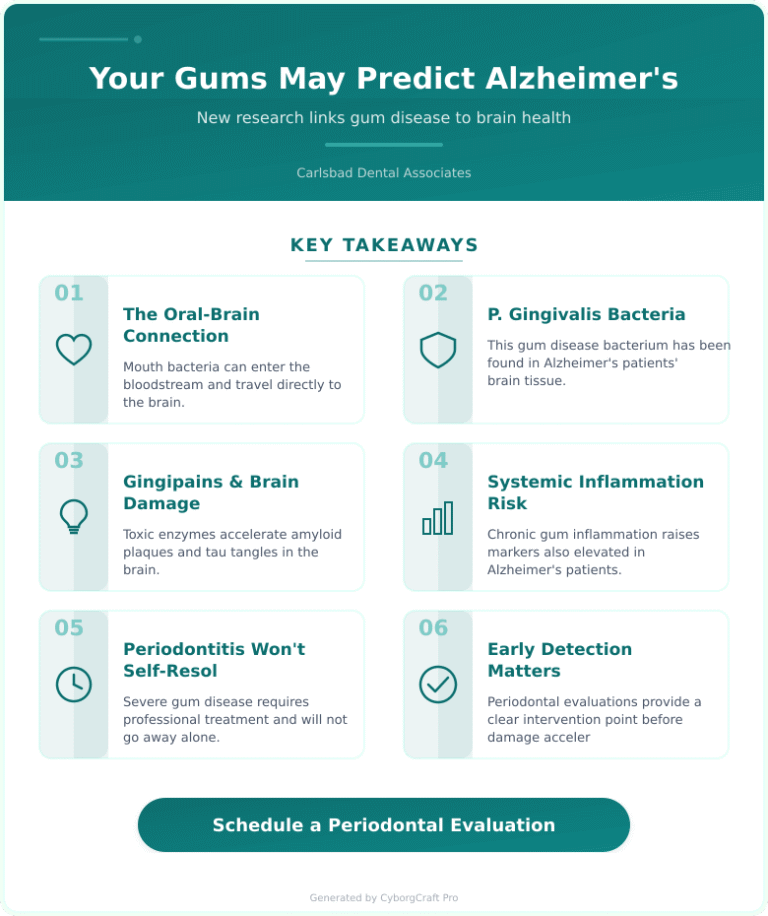
Here’s the thing most people don’t realize: your mouth is not sealed off from the rest of your body. The bacteria living in infected gum tissue – particularly a strain called Porphyromonas gingivalis – can enter your bloodstream and travel to the brain.
According to research published in the journal Science Advances and referenced by the National Institute on Aging, gingipains (toxic enzymes produced by P. gingivalis) have been found in the brain tissue of Alzheimer’s patients. That’s a striking finding. It suggests that the gum disease and Alzheimer’s risk connection isn’t just theoretical – it’s biological and measurable.
Growing bodies of research indicate that adults with severe periodontitis may face an elevated risk of developing dementia compared to adults with healthy gums. Multiple studies have examined long-term outcomes in patients with chronic gum disease and found meaningful associations with Alzheimer’s diagnosis over extended follow-up periods.
That pattern of findings deserves a moment of attention.
Why Gum Bacteria May Damage the Brain
Periodontitis: A severe form of gum disease caused by bacterial infection that destroys the bone and soft tissue supporting your teeth.
Gingipains: Toxic enzymes secreted by P. gingivalis bacteria that can cross the blood-brain barrier and trigger neuroinflammation linked to Alzheimer’s progression.
The mechanism scientists believe is at work involves several overlapping pathways:
- Chronic gum inflammation raises systemic inflammatory markers (like CRP) that are also elevated in Alzheimer’s patients
- Oral bacteria can enter the bloodstream through inflamed gum tissue and migrate to brain tissue
- Gingipains appear to accelerate the buildup of amyloid plaques and tau tangles – the hallmark damage patterns of Alzheimer’s
- The immune system’s prolonged response to gum infection may accelerate neural damage over time
The National Institute of Dental and Craniofacial Research has supported ongoing research to further define these pathways and determine whether treating gum disease can slow cognitive decline.
Thinking about what this means for your own health? You don’t have to figure it out alone. Contact us at Carlsbad Dental Associates and we’ll walk you through what a periodontal evaluation looks like – no pressure at all.
Gum Disease vs. Normal Gum Irritation: Which Approach Works?
Where mild gum irritation succeeds: Responds quickly to improved brushing and flossing. Resolves within days to weeks. Carries no systemic risk when addressed promptly.
Where mild gum irritation fails: Easy to dismiss and ignore. Often painless, so many people assume no treatment is needed. Can quietly progress to periodontitis without obvious warning signs.
Where periodontitis succeeds as a warning signal: Its presence is measurable through clinical pocket depth readings and X-rays. Detection gives you a clear intervention point before systemic damage accelerates.
Where periodontitis fails to self-resolve: It does not go away on its own. It requires professional treatment. Left untreated, it continues to generate bacterial load and inflammatory markers year after year.
The verdict: Early-stage gum problems are manageable with good home care and routine cleanings. Once periodontitis sets in, professional intervention is essential – and the stakes are no longer limited to your teeth.
| Condition | Systemic Risk Level | Self-Treatable? | Treatment Timeline |
|---|---|---|---|
| Gingivitis (early) | Low | Often yes, with better hygiene | 2-4 weeks |
| Mild Periodontitis | Moderate | No – professional cleaning needed | 1-3 months |
| Severe Periodontitis | High (includes brain health) | No – professional care required | Ongoing management |
Your Gum Health Action Plan
- Step 1 – Get a periodontal evaluation: Ask your dentist to measure gum pocket depths. Anything above 3mm warrants closer monitoring. This is the starting point for understanding your actual risk level.
- Step 2 – Upgrade your home care routine: Brush twice daily, floss daily, and consider an antibacterial rinse. The goal is reducing bacterial load consistently, not just occasionally.
- Step 3 – Treat active infection promptly: If periodontitis is diagnosed, scaling and root planing (a deep cleaning procedure) is typically the first-line treatment. Costs vary by region, severity, and provider, so contact your dental office and insurance provider directly for current pricing and coverage details.
- Step 4 – Schedule maintenance visits every 3-4 months: Once periodontitis has been treated, standard 6-month cleanings are often insufficient. More frequent visits reduce re-infection risk.
- Step 5 – Talk to your physician: If you have a family history of Alzheimer’s, share your periodontal status with your primary care doctor. The gum disease and Alzheimer’s risk conversation is becoming a standard part of integrated health care.
Warning Signs You Shouldn’t Ignore
The most common mistake people make is assuming that painless gums are healthy gums. Periodontitis is often silent until significant damage has occurred.
- Gums that bleed when you brush or floss
- Gums that look red, swollen, or pulled away from your teeth
- Persistent bad breath that doesn’t improve with brushing
- Teeth that feel loose or have shifted position
- Sensitivity at the gum line that wasn’t there before
Any one of these signs warrants a professional evaluation. At Carlsbad Dental Associates, patients from Carlsbad, Oceanside, Vista, San Marcos, Encinitas, and across San Diego County come in with these exact concerns. The earlier a problem is caught, the more options you have.
See how our approach to gum health and whole-body wellness compares – explore our services to learn more about what a complete evaluation includes.
Pre-Appointment Checklist
- ☐ Note any bleeding, swelling, or pain in your gums
- ☐ List all medications (some increase gum inflammation risk)
- ☐ Note any family history of Alzheimer’s or dementia
- ☐ Record how long it’s been since your last professional cleaning
- ☐ Ask specifically about periodontal pocket depth measurements
Key Takeaways for Adults
- The connection is real – P. gingivalis bacteria from gum disease have been found in Alzheimer’s brain tissue
- Inflammation is the bridge – chronic gum inflammation raises the same systemic markers found in Alzheimer’s patients
- Early treatment matters – addressing periodontitis before it becomes severe may reduce long-term cognitive risk
- Painless doesn’t mean healthy – gum disease often progresses silently for years
- Research is ongoing – current studies are actively working to define whether treating gum disease can slow or prevent Alzheimer’s progression
Frequently Asked Questions
Does gum disease actually cause Alzheimer’s?
Researchers have established a strong association between gum disease and Alzheimer’s risk, though causation is still being confirmed. Studies have found Alzheimer’s-linked bacteria in brain tissue samples, and ongoing clinical trials are testing whether treating gum disease can reduce cognitive decline rates.
How do I know if I have periodontitis?
A dentist can diagnose periodontitis by measuring the depth of the pockets between your teeth and gums using a small probe. Pockets deeper than 4mm, combined with bone loss visible on X-rays, typically indicate periodontitis rather than early-stage gingivitis.
Can treating gum disease reverse Alzheimer’s risk?
Current evidence suggests that treating active gum disease reduces the bacterial and inflammatory burden associated with Alzheimer’s progression. Whether it can reverse existing risk is still under study, but reducing ongoing infection is considered a net positive for brain health.
How much does periodontal treatment cost without insurance?
Scaling and root planing (deep cleaning) costs vary depending on the severity of the condition, the number of areas treated, and your geographic location. Contact your dental office directly for current pricing, and check with your insurance provider to understand what your plan may cover for periodontal treatment.
How often should I see a dentist if I have gum disease?
Most dental professionals recommend visits every 3-4 months for patients with active or treated periodontitis, rather than the standard 6-month schedule. More frequent maintenance significantly reduces the risk of re-infection and disease progression.
Are some people more at risk for both gum disease and Alzheimer’s?
Yes – risk factors like diabetes, smoking, poor nutrition, and genetic predisposition increase vulnerability to both conditions simultaneously. Adults with a family history of Alzheimer’s should discuss periodontal monitoring as part of their broader preventive health strategy.
What This Means for You Right Now
You don’t need to wait for a headline to make a move on this. If you can’t remember your last periodontal evaluation, that’s the starting point. The research on gum disease and Alzheimer’s risk is adding real weight to something dentists have long emphasized: your oral health is inseparable from your overall health.
Ready to take the next step? Contact Carlsbad Dental Associates today for straight answers and a real assessment of your gum health. Our office is located at 5814 Van Allen Way #220, Carlsbad, CA 92008, and we welcome patients from throughout the greater San Diego area. The earlier you act, the more options you have.
Disclaimer: This content is for educational purposes only and is not a substitute for professional medical or dental advice. If you have concerns about your gum health or cognitive health, consult a licensed healthcare provider.