Dental implant regeneration is the process of rebuilding lost bone and tissue to support a permanent tooth replacement. As of 2026, new approaches using biological scaffolding and printed bone structures are making implants possible for patients who were previously told they lacked sufficient bone.
This guide focuses specifically on the 2026 regenerative implant advances available to patients in Carlsbad and surrounding North County communities – and what they actually mean for your treatment options.
Dental Implant Regeneration Definition: A clinical process that rebuilds jawbone and soft tissue using biological or synthetic scaffolding materials, allowing a titanium or ceramic implant to integrate with the jaw for long-term tooth replacement.
For years, patients with significant bone loss heard the same answer: you need a bone graft, and that means a longer timeline, more procedures, and recovery measured in months. That answer is still sometimes true. But the science behind what goes into that graft – and how it behaves once it’s placed – has shifted considerably since 2025. Patients coming through the door at Carlsbad Dental Associates are asking sharper questions, and they deserve straight answers.
Why Bone Loss Makes Implants Complicated
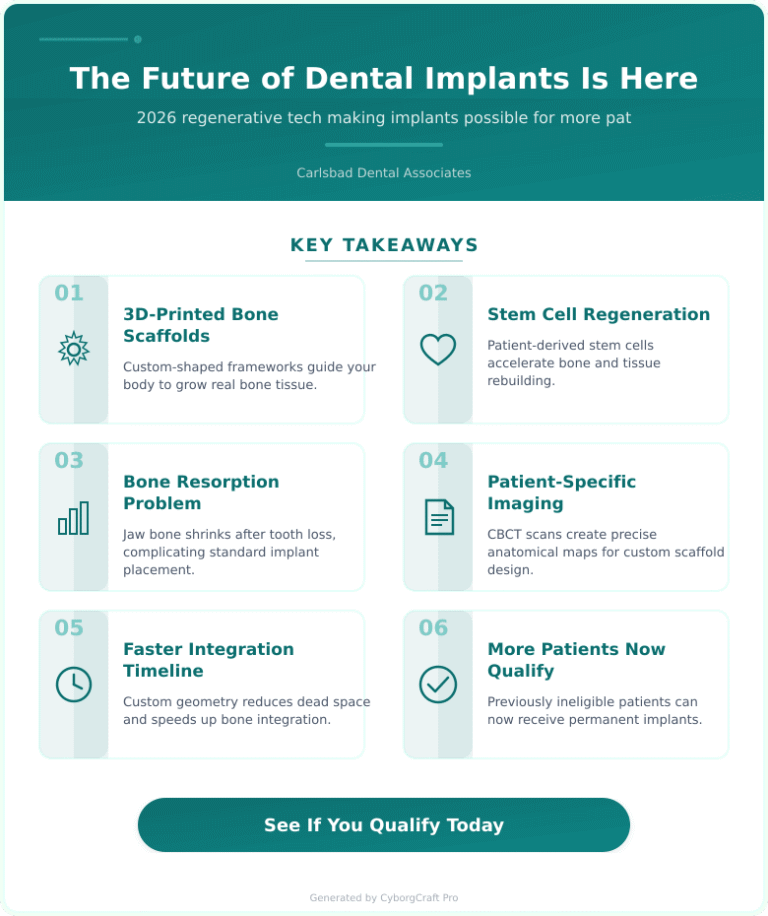
When a tooth is lost, the jawbone underneath begins to shrink. Without the daily pressure of chewing, the body stops maintaining that bone density. Bone resorption following tooth loss can progress meaningfully over the months and years after extraction. After several years, that loss can be dramatic enough to make standard implant placement risky or impossible without a graft.
Bone resorption: The biological process by which the body gradually breaks down and absorbs jaw bone tissue after tooth loss, reducing the volume available for implant anchoring.
Traditional grafting options – using bone from the patient’s own body, a donor, an animal source, or a synthetic material – have been effective for decades. But each comes with trade-offs: harvest site discomfort, variable integration rates, and extended waiting periods before the implant can be placed. A meaningful number of patients who need bone grafts delay treatment or do not complete it, often due to these factors.
What 3D-Printed Bone Actually Is
The term sounds like science fiction, but the technology behind printed bone scaffolds is straightforward once you break it down. A bioprinter uses a patient’s own imaging data – typically from a CBCT (cone beam computed tomography) scan – to fabricate a scaffold shaped precisely to the defect in their jaw. That scaffold is made from biocompatible materials, often hydroxyapatite or tricalcium phosphate, which are naturally found in human bone.
The scaffold doesn’t become permanent bone on its own. It acts as a framework that the body’s own cells migrate into, populate, and eventually replace with real bone tissue. The printed structure dissolves as new bone forms around it. What makes this different from traditional grafting is the fit: custom geometry matched to the patient’s exact anatomy reduces dead space and improves integration speed.
Research into bone regeneration increasingly supports the role of patient-specific scaffold geometry in improving precision and clinical outcomes. The National Institute of Dental and Craniofacial Research is among the institutions supporting ongoing work in this area. That precision is what custom printing delivers.
Want to explore whether this applies to your situation? Contact us and we’ll walk you through your options – no pressure.
Where Stem Cells Enter the Picture
Stem cell applications in dental regeneration are moving from research settings into clinical practice in 2026. The most common source? The patient’s own extracted teeth or, more recently, bone marrow aspirate taken from a minimally invasive draw near the implant site.
These autologous (patient-derived) cells are concentrated and applied directly to the graft site, where they accelerate the recruitment of bone-forming cells called osteoblasts. Early clinical results suggest this approach can meaningfully reduce healing timelines compared to traditional grafting alone.
Autologous stem cell concentrate: A preparation of growth-factor-rich cells derived from the patient’s own biological material, used to accelerate tissue healing and bone formation at a surgical site.
This isn’t a replacement for the graft – it’s an enhancement. Think of the printed scaffold as the structure and the stem cell concentrate as the biological signal that tells your body to fill it in faster. The combination is what makes same-year implant placement realistic for patients who once faced 12-plus months of staged procedures.
Traditional Bone Graft vs Regenerative Approach: Which Works Better?
| Factor | Traditional Bone Graft | 3D Scaffold + Stem Cell Concentrate |
|---|---|---|
| Customization | Limited – shaped manually | Patient-specific geometry from scan data |
| Healing Timeline | Typically longer; varies by case | Potentially shorter in qualifying cases |
| Harvest Site Pain | Yes, if autogenous | Minimal – aspirate only |
| Integration Rate | Generally favorable based on long-term data | Promising early results in clinical settings |
| Cost Range (2026) | Varies by case, material, and provider | Typically higher than traditional grafting; varies by case |
| Availability | Widely available | Select practices – growing in 2026 |
Where traditional grafting succeeds: Proven long-term data, wide availability, lower upfront cost, and strong outcomes for moderate bone defects.
Where traditional grafting falls short: Longer timelines, possible donor site discomfort, and less precise fit in complex defects.
Where the regenerative approach succeeds: Faster healing in qualifying patients, custom fit, reduced discomfort, and strong early integration data.
Where the regenerative approach falls short: Higher cost, limited availability outside larger practices, and less long-term follow-up data than traditional methods.
The verdict: For straightforward defects, traditional grafting remains a reliable and cost-effective choice. For complex cases, patients with prior graft failures, or anyone who wants the shortest possible treatment timeline, the 2026 regenerative approach is worth asking about specifically.
See how our approach fits your case – explore our services or reach out to start the conversation.
Your Dental Implant Regeneration Action Plan
- Step 1 – Get a CBCT Scan: A 3D cone beam scan shows exact bone volume and density. This is the foundation for any regenerative treatment plan.
- Step 2 – Review Graft Options with Your Dentist: Ask specifically whether a custom scaffold or stem cell concentrate is appropriate for your defect size and location.
- Step 3 – Confirm Insurance and Out-of-Pocket Costs: Most dental insurance covers traditional grafting at 50-80%. Regenerative enhancements are typically out-of-pocket. Get a written estimate before committing.
- Step 4 – Complete the Regenerative Phase: Allow full healing time as directed – skipping follow-up imaging is the most common reason integrations fail.
- Step 5 – Implant Placement: Once bone density meets threshold, implant placement proceeds. With regenerative methods, this phase often arrives months earlier than expected.
- Step 6 – Restoration and Maintenance: The implant crown is placed and a maintenance schedule begins. Annual imaging confirms ongoing bone health around the implant.
What Patients in Carlsbad Should Know Right Now
Not every office offering implants in 2026 is equipped for advanced regenerative techniques. Patients in Carlsbad, Oceanside, Vista, San Marcos, Encinitas, and the broader San Diego North County area should ask directly whether their provider has access to bioprinting partnerships or uses stem cell concentrates in-house versus referring out.
The most common mistake we see is patients assuming all bone grafting is the same. It’s not. Material quality, technique, and the biological adjuncts used vary significantly between practices – and those differences affect how quickly you heal and whether your implant succeeds long-term.
At Carlsbad Dental Associates, located in Carlsbad, CA, we stay current with the advances that matter to patients here. If you’ve been told you don’t have enough bone for an implant, that conversation may be worth revisiting in 2026.
Frequently Asked Questions
Are stem cell dental treatments FDA-approved in 2026?
Certain stem cell concentrate preparations used in dental bone regeneration have received FDA clearance as of 2026. These are typically classified as autologous tissue preparations rather than drug therapies, which affects their regulatory pathway. Always ask your provider which specific products they use and confirm clearance status.
How much does 3D-printed bone grafting cost without insurance?
Custom scaffold-based bone grafting costs vary depending on case complexity, materials, and provider. This is generally higher than traditional grafting. These figures differ across providers and regions – your provider will give you a case-specific estimate.
Does dental insurance cover regenerative implant procedures?
Traditional bone grafts are covered at 50-80% by most dental plans, but advanced regenerative enhancements like stem cell concentrates are typically not covered. Check your plan’s major restorative benefit language and ask for a pre-authorization before scheduling.
How long does recovery take with the new regenerative techniques?
Patients using 3D-printed scaffolds with stem cell concentrate may experience shorter bone maturation timelines in qualifying cases compared to traditional grafts. Individual results depend on defect size, systemic health, and patient compliance with post-procedure care.
Who is a good candidate for these advanced grafting methods?
Patients with large or irregular bone defects, prior graft failures, or complex anatomy are the strongest candidates for regenerative approaches. A CBCT scan and a consultation with a dentist familiar with current regenerative options will clarify whether traditional or advanced grafting fits your specific case.
How do I verify that a dental provider is qualified to place implants?
In California, implant placement must be performed by a licensed DDS or DMD, with specialty procedures often handled by periodontists or oral surgeons. You can verify California dental licenses through the Dental Board of California. Ask specifically about the provider’s implant volume and whether they partner with specialty labs for custom scaffold fabrication.
What This Means for You
The gap between “you don’t have enough bone” and “we can help you” is narrowing fast in 2026. If you were told no in 2023 or 2024, the answer today may be different. These advances aren’t hypothetical – they’re arriving in clinical settings across California this year, and 2027 will bring even more accessible versions of this technology.
Ready to find out what’s actually possible for your case? Contact us today for a straight conversation about your options. We’re here to help patients across Carlsbad and North County understand what modern implant care can actually do.
This content is for educational purposes only and is not a substitute for professional dental advice. Always consult a licensed dental provider for diagnosis and treatment recommendations.