
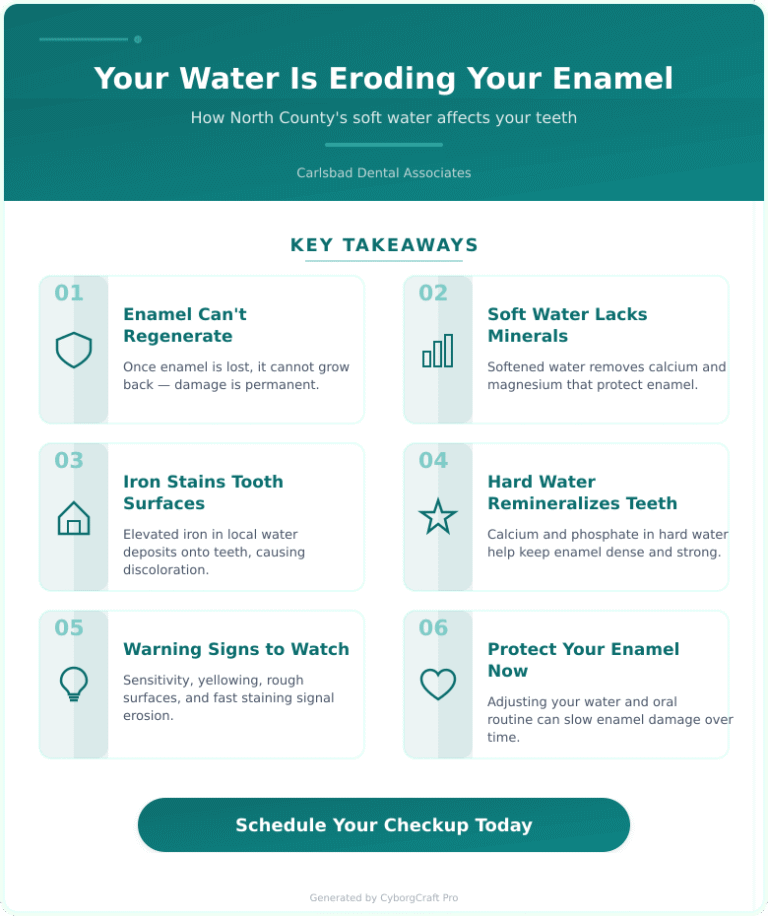
This guide focuses specifically on how North County San Diego’s iron-heavy, treated soft water affects enamel health and what Carlsbad residents can do about it.
Enamel Erosion Definition: Enamel erosion is the irreversible loss of the hard outer surface of a tooth, triggered by acid exposure, mineral imbalance, or chemical contact over time.
If you’ve noticed orange or rust-colored rings in your toilet bowl, or your skin feels unusually slippery after a shower, you’re already living with the effects of North County’s water profile. That same water runs over your teeth every time you brush, rinse, or drink from the tap. Enamel is widely recognized in dentistry as the hardest substance in the human body, and it has one critical weakness: it cannot regenerate once damaged.
At Carlsbad Dental Associates, we see the effects of local water quality in our patients regularly. The pattern is consistent enough that it’s worth understanding before your next checkup reveals something unexpected.
What’s Actually in North County Water
North County draws water from a variety of municipal and regional sources. Local water may contain elevated iron content depending on the supply and infrastructure. Many homes and buildings also run water through softening systems, which swap calcium and magnesium ions for sodium ions through an ion-exchange process.
Iron: A naturally occurring mineral that, at elevated levels, deposits onto tooth surfaces and contributes to surface staining over time.
Softened water: Water that has been treated to remove hardness minerals, resulting in a lower mineral content overall and sometimes a slightly higher sodium profile that can affect salivary chemistry.
Here’s the problem. Hard water, despite its rough reputation, actually delivers calcium and phosphate to your teeth with every sip. Those minerals help remineralize enamel and keep its surface dense. Softened water strips that benefit away. You’re left with water that’s easier on your pipes but offers less protective value for your teeth.
The combination of iron staining and reduced mineral delivery is a slow but measurable contributor to enamel thinning over time, and it is worth keeping in mind as part of your overall oral health routine.
Signs Your Enamel Is Taking the Hit
- Teeth feel sensitive to cold drinks or sweet foods
- Visible yellowing or a translucent appearance near the tips of front teeth
- Surface feels rough or develops tiny chips without any obvious trauma
- Orange or brownish staining that forms quickly even after a cleaning
- Gums appear to recede, exposing softer root surfaces to the same water
The most common mistake we see is patients attributing these symptoms to teeth grinding or aging alone. Water chemistry is rarely mentioned, but it belongs in the conversation.
Research from the National Institute of Dental and Craniofacial Research and other dental health organizations indicates that enamel erosion is common among young adults in the U.S., with dietary and environmental acid exposure as leading causes. In areas with compromised water mineral profiles, the risk may trend higher.
Thinking about whether your water could be affecting your teeth? Let’s talk. Contact us and we’ll walk you through what to look for, no pressure.
Soft Water vs. Hard Water: Which Is Worse for Enamel?
| Factor | Hard Water | Soft Water | Impact on Enamel |
|---|---|---|---|
| Calcium content | High | Low to none | Hard water supports remineralization |
| Magnesium content | Moderate | Removed | Hard water offers mild protection |
| Sodium content | Low | Elevated | Soft water may affect saliva buffering |
| Iron content | Variable | Variable | Iron causes staining and surface wear |
| pH level | Neutral to alkaline | Slightly lower | Lower pH increases acid risk to enamel |
Where hard water succeeds: It delivers trace minerals that help maintain enamel density and buffer against acidic foods and drinks.
Where hard water fails: Scale buildup on teeth and fixtures, can feel unpleasant, and contributes to tartar formation at the gum line.
Where soft water succeeds: Easier on appliances, produces less scale, and feels better for washing.
Where soft water fails: Removes enamel-supporting minerals, may increase susceptibility to acidic erosion, and offers no remineralization benefit.
The verdict: For your teeth specifically, hard water wins on mineral support, but neither is ideal on its own. The solution is supplementing with fluoride, professional care, and smart hydration habits.
Your Enamel Protection Action Plan
- Step 1 – Test your water: Get a basic home water test or contact your local utility for a report. Knowing your iron and sodium levels gives you a clear starting point.
- Step 2 – Switch to fluoride toothpaste: Fluoride actively supports remineralization and helps offset the mineral deficiency in softened water. Use it twice daily without rinsing immediately after.
- Step 3 – Rinse with filtered or bottled water: After brushing, a final rinse with low-iron, naturally mineralized water reduces the iron contact your enamel experiences daily.
- Step 4 – Limit acidic foods after soft-water exposure: Citrus, soda, and vinegar-based foods create an acidic environment that worsens the mineral loss soft water already triggers.
- Step 5 – Schedule a professional cleaning and assessment: A dentist can identify early erosion that’s not yet visible or symptomatic, before it requires restoration.
Before Your Appointment: What to Prepare
- ☐ Note any sensitivity or pain when drinking cold or sweet items
- ☐ Check for visible staining or discoloration near the gum line
- ☐ Bring your water utility report if available
- ☐ List any teeth-whitening or abrasive products you currently use
- ☐ Mention if you use a water softener at home
See how our approach to enamel care compares to doing nothing. Explore our services and find out what a proactive cleaning and exam can catch early.
Key Takeaways for Carlsbad Residents in 2026
- Soft water removes protective minerals – your enamel misses the calcium and magnesium that naturally hard water provides
- Iron staining signals contact risk – if iron is marking your fixtures, it’s touching your teeth too
- Enamel does not regenerate – early detection is the only real advantage you have
- Fluoride is your main defense – it partially compensates for the mineral gap soft water creates
- Regular professional checkups catch what mirrors miss – erosion often starts below the surface
Frequently Asked Questions
Can soft water actually damage my teeth?
Soft water does not directly damage teeth, but it removes minerals that enamel relies on for daily remineralization. Over time, without calcium and magnesium in your water, enamel becomes more vulnerable to acidic foods, drinks, and surface wear from brushing.
Is the iron in North County water dangerous for my enamel?
Iron at levels found in some local water supplies is not medically dangerous, but it can contribute to surface staining on enamel over time. The staining itself is a sign of regular iron contact, which can gradually roughen the enamel surface and make it more susceptible to bacterial buildup.
How do I know if my enamel is already eroding?
Early enamel erosion shows up as increased tooth sensitivity, slight yellowing, or a translucent edge on front teeth. A dentist can detect erosion in its early stages using a clinical exam, often before you notice any discomfort yourself.
Does fluoride in tap water protect against soft-water damage?
Fluoride in municipal water helps strengthen enamel but does not replace the remineralization benefit of calcium and magnesium. Using fluoride toothpaste adds an additional protective layer, especially for households using softened water.
How often should I get a dental checkup if I live in a soft-water area?
Most dental professionals recommend checkups every six months, and that frequency is especially useful if you’re in a soft-water area with elevated iron. More frequent visits may be appropriate if early erosion has already been identified.
What does enamel erosion treatment cost without insurance?
Treatment costs depend on how far erosion has progressed, ranging from simple fluoride treatments to bonding or crowns for advanced cases. Nationally, preventive fluoride applications run $20-$50 per visit, while restorative bonding typically ranges from $300-$600 per tooth (2026 industry averages).
What This Means for You in North County
Carlsbad and the surrounding communities, including Oceanside, Vista, San Marcos, Encinitas, and Escondido, share a similar water profile. The iron staining you see on your fixtures is a visible clue about what’s happening to your enamel over months and years of daily contact.
The good news is this is manageable. You don’t need to overhaul your plumbing or stop drinking tap water. You need awareness, a consistent oral care routine, and a dentist who understands the local environment you’re living in.
Ready to find out where your enamel stands? Contact Carlsbad Dental Associates today and schedule an exam. Early answers mean simpler solutions, and that’s always worth a conversation.
This content is for educational purposes only and is not a substitute for professional dental advice. If you are experiencing pain, sensitivity, or visible tooth damage, please consult a licensed dental professional.