
Skipping dental cleanings is the habit of postponing or canceling routine professional dental visits, often allowing plaque, tartar, and bacterial buildup to progress unchecked. What feels like a minor schedule choice can quietly become one of the more expensive oral health decisions you make.
This guide focuses specifically on what actually accumulates in your mouth during 12 months of missed cleanings, and the real costs-financial and health-related-that follow.
The pattern shows up constantly in dental offices: a patient walks in after a year-plus gap, convinced their teeth feel fine. Then the X-rays and exam tell a different story. The most common finding is not a dramatic emergency but a slow, steady progression of problems that could have been stopped early for a fraction of what treatment now requires.
What Actually Happens Inside Your Mouth Over 12 Months
Tartar (calculus): Hardened plaque that can no longer be removed by brushing alone. Once tartar forms, only professional scaling removes it.
Periodontal disease: A bacterial infection of the gum tissue and bone supporting your teeth. Early stages are reversible; advanced stages are not.
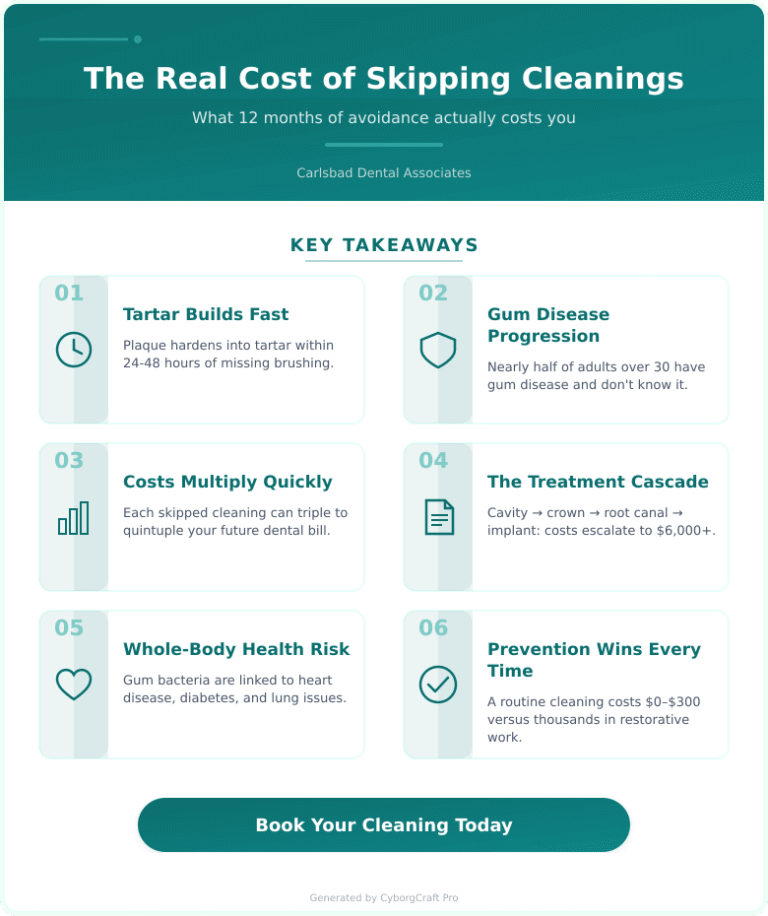
Plaque begins accumulating on tooth surfaces quickly after brushing. Within 24-48 hours, plaque hardens into tartar along the gumline. Over time, tartar deposits can irritate gum tissue, and without professional removal, inflammation may progress into gum disease and eventually affect the bone supporting your teeth. According to the National Institute of Dental and Craniofacial Research, nearly half of adults over 30 in the United States have some form of periodontal disease-and most are unaware of it.
Patients who skip consecutive cleanings are at greater risk of requiring restorative work down the line. That is not a scare tactic. That is the biology of bacterial accumulation.
Skipping Cleanings vs. Staying on Schedule: A Real Cost Comparison
Where staying on schedule succeeds: Early cavity detection saves hundreds. Tartar removal prevents gum disease. Professional polishing reduces staining. Oral cancer screenings catch issues in treatable stages.
Where staying on schedule fails: It requires time and a copay. For the uninsured, twice-yearly cleanings can feel like an unnecessary expense in a given month.
Where skipping succeeds: Short-term cost avoidance. Nothing more.
Where skipping fails: A cleaning missed becomes a cavity found. A cavity untreated becomes a root canal needed. A root canal neglected can mean extraction and an implant. Each step multiplies cost by three to five times the original cleaning fee.
The verdict: The math does not favor avoidance. Routine cleanings cost a fraction of the restorative procedures they prevent. A single crown represents a significant out-of-pocket expense, and periodontal treatment for advanced gum disease can cost considerably more. Skipping cleanings is borrowing against a bill you will eventually pay with interest.
| Scenario | Typical Cost (2026) | Timeline | Outcome |
|---|---|---|---|
| Routine cleaning (with insurance) | $0-$50 copay | 45-60 min | Prevention maintained |
| Routine cleaning (no insurance) | $100-$300 | 45-60 min | Prevention maintained |
| Filling (early cavity) | $150-$400 | 1 visit | Tooth preserved |
| Crown (untreated cavity) | $1,200-$1,800 | 2 visits | Tooth preserved |
| Root canal + crown | $2,000-$3,500 | 2-3 visits | Tooth preserved (maybe) |
| Implant (lost tooth) | $3,500-$6,000 | 3-6 months | Replacement |
Thinking about this for your situation? Let’s talk. Contact us and we’ll walk you through your options with no pressure-just straight answers.
The Mouth-Body Connection You Cannot Ignore
Periodontal bacteria do not stay local. Research published through the American Dental Association has linked chronic gum infection to elevated cardiovascular risk, poorly controlled blood sugar in diabetic patients, and respiratory complications. This is not a fringe theory. It is a well-documented systemic relationship.
Twelve months of missed cleanings means twelve months of unchecked bacterial inflammation. For most healthy adults, the visible damage takes time to surface. But the low-grade systemic burden is accumulating the entire time.
Your Dental Health Re-Entry Action Plan
- Step 1 – Book an exam first: A complete exam including X-rays will establish a baseline and identify any existing issues before a hygienist begins scaling.
- Step 2 – Be honest about your history: Tell the dental team exactly how long it has been. No judgment. That information shapes the type of cleaning and care plan recommended.
- Step 3 – Expect a deeper cleaning if needed: After 12 months, a standard prophylaxis may not be sufficient. Scaling and root planing (a deep cleaning below the gumline) may be recommended. It is not a punishment for waiting-it is the clinically appropriate response to what has accumulated.
- Step 4 – Address active issues immediately: Do not schedule the cleaning and postpone the cavity. Treating cavities while they are small costs significantly less than waiting.
- Step 5 – Set a schedule and protect it: Every six months is the standard. Some patients with gum disease history benefit from every three to four months. Your care team will guide the right interval for you.
What to Bring and Expect at Your First Appointment Back
- ☐ Insurance card and photo ID
- ☐ List of current medications (some affect gum health and bleeding)
- ☐ Any past dental X-rays if switching providers
- ☐ Notes on sensitivity, pain, or anything that feels different
- ☐ Questions about financing or payment plans if cost is a concern
At Carlsbad Dental Associates, patients coming in after a long gap are seen without judgment. The goal is always to understand where you are starting from and build a plan that makes sense for your health and your budget. The office is located in Carlsbad, CA, and serves patients from Oceanside, Vista, San Marcos, Encinitas, Leucadia, La Costa, and the surrounding North County communities.
Key Takeaways for Carlsbad Patients in 2026
- Tartar forms fast – within days, and only a professional can remove it once it hardens
- The cost gap is real – a cleaning costs a fraction of any restorative procedure it prevents
- Gum disease is silent early – most patients feel nothing until it is well established
- The systemic link matters – oral bacteria affect more than just your teeth
- Re-entry is easier than you think – one appointment resets the clock and gives you a clear path forward
Frequently Asked Questions
How much does a dental cleaning cost without insurance in California?
A standard prophylaxis cleaning in California typically runs $100-$300 out of pocket in 2026, depending on the office and the level of care needed. Patients who need a deep cleaning (scaling and root planing) after extended avoidance can expect higher costs, generally $200-$400 per quadrant.
Is one missed year of cleanings really that serious?
For many patients, 12 months of missed cleanings is long enough for tartar to accumulate significantly and early gum disease to establish itself. The severity depends on your individual oral hygiene habits, diet, and genetics, but the risk of requiring restorative treatment rises noticeably after a year-long gap.
Will a cleaning hurt after a long gap?
Sensitivity during cleaning is common after extended avoidance, especially if gum inflammation is present. Most patients find the discomfort manageable, and dental teams can use numbing gel or local anesthetic if needed. The sensitivity typically resolves within a day or two.
How often should I get dental cleanings?
Most adults benefit from professional cleanings every six months, as recommended by current clinical guidelines. Patients with active gum disease or a history of periodontal issues may need appointments every three to four months to maintain stability.
Does dental insurance cover cleanings?
Most dental insurance plans cover preventive cleanings at 100% with no copay, typically twice per year. Coverage details vary by plan, so confirming your specific benefits before your appointment is always a smart step.
Can I just brush and floss more to make up for missed cleanings?
Good home hygiene helps, but it cannot remove tartar once it has hardened onto the tooth surface. Brushing and flossing maintain what professional cleaning establishes-they are not a substitute for it.
What is scaling and root planing?
Scaling and root planing is a deep cleaning procedure that removes tartar and bacterial deposits from below the gumline, then smooths the root surface to discourage reattachment. It is the standard first-line treatment for patients diagnosed with periodontitis and is performed under local anesthetic.
This content is for informational purposes only and is not a substitute for professional dental advice, diagnosis, or treatment. If you are experiencing dental pain or an urgent concern, seek care promptly.
The Bottom Line for North County Residents
A year of avoided cleanings is not a clean slate waiting to happen. It is a year of bacterial accumulation, tartar buildup, and slow gum inflammation that the body cannot reverse on its own. The good news: none of this is permanent if you act now. One appointment resets the foundation. Two appointments a year keep it there.
Ready to take the next step? Contact Carlsbad Dental Associates today for straight answers and a care plan built around where you actually are-not where you think you should be. Explore our services to see the full range of preventive and restorative care available to you.