
Invisalign vs braces is one of the most searched orthodontic questions adults type into Google every single day. Both options straighten teeth effectively, but they work differently, cost differently, and feel completely different in your daily life.
This guide focuses specifically on helping adults in Carlsbad and greater San Diego County decide which orthodontic treatment fits their lifestyle, budget, and treatment goals in 2026.
Invisalign Definition: Invisalign is a clear aligner system that uses a series of custom-fitted, removable plastic trays to gradually shift teeth into alignment without metal brackets or wires.
Traditional Braces Definition: Traditional braces are fixed orthodontic appliances bonded directly to teeth, using metal or ceramic brackets connected by wires to move teeth over time.
The most common mistake adults make is choosing based on aesthetics alone. Cost, treatment complexity, and your own daily habits all matter just as much. According to the American Dental Association, orthodontic treatment success depends heavily on patient compliance, which is where these two options diverge most dramatically.
How Each Option Actually Works
Invisalign uses a series of removable trays, each worn for about one to two weeks. You take them out to eat, drink, brush, and floss. The trays apply gentle, targeted pressure to shift teeth gradually. You typically swap trays at home and check in with your provider every six to eight weeks.
Traditional braces stay on your teeth the entire treatment. Your provider tightens the wires at appointments every four to six weeks, and that consistent tension moves teeth continuously. Because they never come off, compliance is essentially automatic.
Here’s the thing most providers won’t say upfront: Invisalign only works as well as you wear it. The trays must be in your mouth 20 to 22 hours per day. Adults who travel frequently, forget to put trays back in after meals, or struggle with consistency often see slower results or need additional trays at extra cost.
Invisalign vs Braces: Which Approach Works?
Where Invisalign succeeds: Virtually invisible during daily wear, removable for eating and oral hygiene, fewer emergency appointments for broken hardware, and generally more comfortable for soft tissue.
Where Invisalign fails: Requires strict discipline with wear time, less effective for severe bite corrections or complex tooth rotations, trays can warp if exposed to heat, and total cost can rise if additional trays are needed.
Where traditional braces succeed: Work continuously without patient compliance, highly effective for complex cases including significant crowding or bite issues, generally lower starting cost, and no risk of trays being lost or forgotten.
Where traditional braces fail: Visible metal hardware, dietary restrictions (no sticky or hard foods), harder to clean around brackets, and potential for mouth sores from wires.
The verdict: Adults with mild to moderate crowding who have strong daily discipline tend to do well with Invisalign. Adults with more complex bite issues, or those who know they won’t consistently wear trays, typically get more reliable results with traditional braces. Neither option is universally superior.
Thinking about this for your situation? Let’s talk. We’ll walk you through your options-no pressure. Contact us to schedule a no-obligation conversation.
Cost Comparison: What to Expect in 2026
| Option | Typical Cost Range (2026) | Treatment Duration | Best For |
|---|---|---|---|
| Invisalign | $3,500 – $8,500 | 12 – 24 months | Mild to moderate cases, appearance-conscious adults |
| Traditional Metal Braces | $2,500 – $6,500 | 18 – 36 months | Complex cases, patients needing passive compliance |
| Ceramic Braces | $3,000 – $7,500 | 18 – 36 months | Adults wanting less visibility with fixed reliability |
These are general industry ranges, not practice-specific fees. California residents should check with their dental insurance provider, as some PPO plans cover orthodontics for adults up to a lifetime maximum (commonly $1,000 to $2,000 per person in 2026). Flexible Spending Accounts (FSA) and Health Savings Accounts (HSA) can also offset out-of-pocket costs significantly.
The cost difference between clear aligners and traditional braces varies depending on case complexity, provider, and location, so consulting with a qualified orthodontic provider is the most reliable way to compare your actual out-of-pocket costs.
Your Invisalign vs Braces Decision Checklist
- Step 1 – Assess complexity: Get a full orthodontic evaluation to understand whether your case is mild, moderate, or complex. Severe crowding or bite issues may limit your options immediately.
- Step 2 – Be honest about compliance: Ask yourself genuinely whether you will wear trays 20+ hours per day, every day, for a year or more. Honesty here saves money later.
- Step 3 – Review your insurance: Call your insurer and ask specifically whether orthodontic benefits apply to adult treatment and whether brand-specific restrictions apply to Invisalign.
- Step 4 – Compare total cost, not just starting cost: Factor in potential refinement trays for Invisalign or extended treatment time for braces when comparing options.
- Step 5 – Consider your lifestyle: Frequent public speaking, active dating life, or a job requiring a polished appearance may make Invisalign worth the premium. Athletes in contact sports often prefer removable trays.
Pre-Appointment Preparation Checklist
- ☐ Gather your current dental insurance card and policy details
- ☐ List any prior orthodontic treatment (previous braces, retainers, palate expanders)
- ☐ Note any jaw pain, clicking, or bite discomfort to mention at your consult
- ☐ Write down your timeline goals (wedding, event, job change)
- ☐ Confirm whether your general dentist has completed any outstanding restorative work first
At Carlsbad Dental Associates, we serve patients from Carlsbad, Oceanside, Vista, San Marcos, Encinitas, La Costa, Leucadia, and the broader North County San Diego area. Our team can help you figure out which path makes sense for your teeth, your schedule, and your budget.
Key Takeaways for Adults Comparing Options in 2026
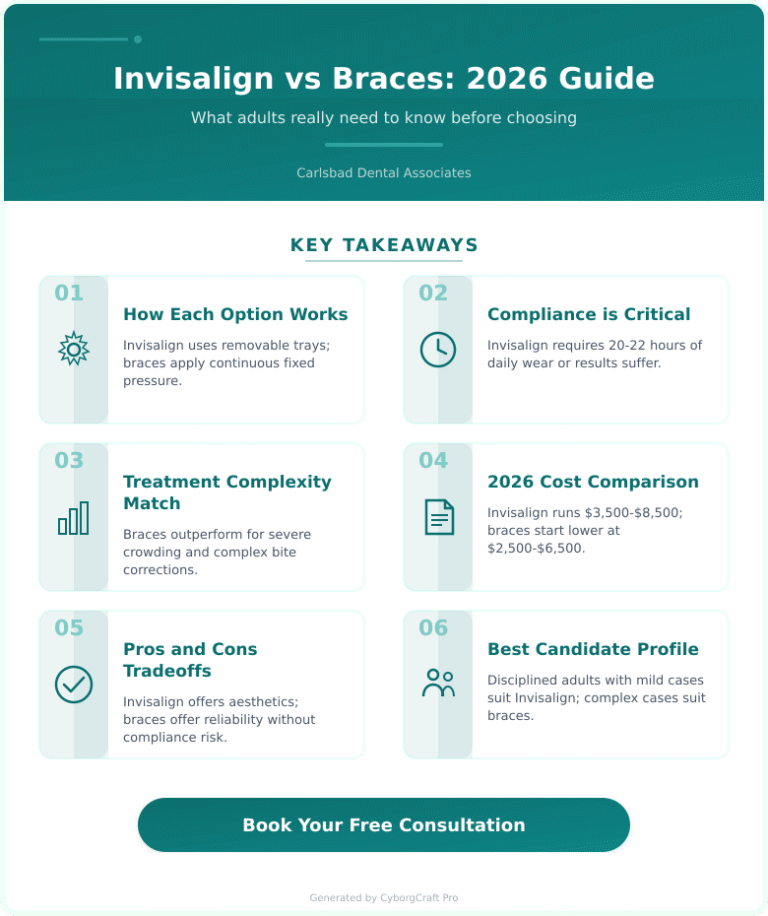
- Compliance drives Invisalign results – wear time discipline is non-negotiable for success
- Braces handle complexity better – for significant bite correction, fixed appliances remain more predictable
- Cost gap is narrowing in 2026 – the price difference between clear aligners and braces is smaller than in prior years
- Insurance and FSA/HSA can help – adult orthodontics is often partially covered, always worth checking
- Lifestyle fit matters as much as clinical outcome – the best treatment is the one you actually complete
Frequently Asked Questions
How much does Invisalign cost without insurance in 2026?
Invisalign typically costs between $3,500 and $8,500 out of pocket in 2026, depending on case complexity and provider. Full-arch, complex cases fall toward the higher end. Many providers offer payment plans, and FSA or HSA funds can be applied to reduce the cost.
Is Invisalign covered by dental insurance?
Many dental PPO plans include orthodontic benefits that apply to Invisalign, though coverage caps typically range from $1,000 to $2,000 lifetime. Check your specific policy for adult orthodontic eligibility, since some plans only cover patients under age 18.
How long does orthodontic treatment take with Invisalign vs braces?
Invisalign treatment for adults typically runs 12 to 24 months, while traditional braces average 18 to 36 months. Simpler cases can finish faster with either option. Non-compliance with Invisalign wear time extends treatment significantly.
Does Invisalign hurt?
Invisalign causes mild pressure and soreness when you switch to a new tray, usually lasting one to three days. Most patients describe it as less painful than tightening appointments for traditional braces. Over-the-counter pain relievers manage discomfort effectively.
Can adults get traditional braces or is Invisalign the only option?
Adults can choose traditional metal braces, ceramic braces, or Invisalign clear aligners based on clinical need and personal preference. There is no age limit on any of these options. Complex bite corrections sometimes make fixed braces the clinically preferred choice regardless of age.
What happens after orthodontic treatment ends?
Both Invisalign and braces require retainers after treatment to prevent teeth from shifting back. Retainers are typically worn full-time initially, then at night long-term. Skipping retainer use is the leading cause of orthodontic relapse. Learn more about our services including retention planning.
How do I verify that a provider is qualified to offer orthodontic treatment?
In California, any licensed dentist (DDS or DMD) can legally offer Invisalign and orthodontic treatment. The California Dental Board at dbc.ca.gov allows you to verify any provider’s license status. Orthodontists have completed an additional two to three years of residency specifically in tooth movement.
Your Next Step Starts Here
Choosing between Invisalign and braces is genuinely personal. The right answer depends on your teeth, your habits, your timeline, and how much the visibility of treatment matters in your daily life. Neither option is wrong. Both work. The difference is in the fit.
Ready to take the next step? Contact us today for straight answers and real solutions. Our team at Carlsbad Dental Associates will walk you through exactly what your treatment would look like, what it would cost, and how long it would take – before you commit to anything.
Disclaimer: This content is for informational purposes only and is not a substitute for professional dental advice, diagnosis, or treatment. Always consult a qualified dental provider regarding your specific orthodontic needs.