
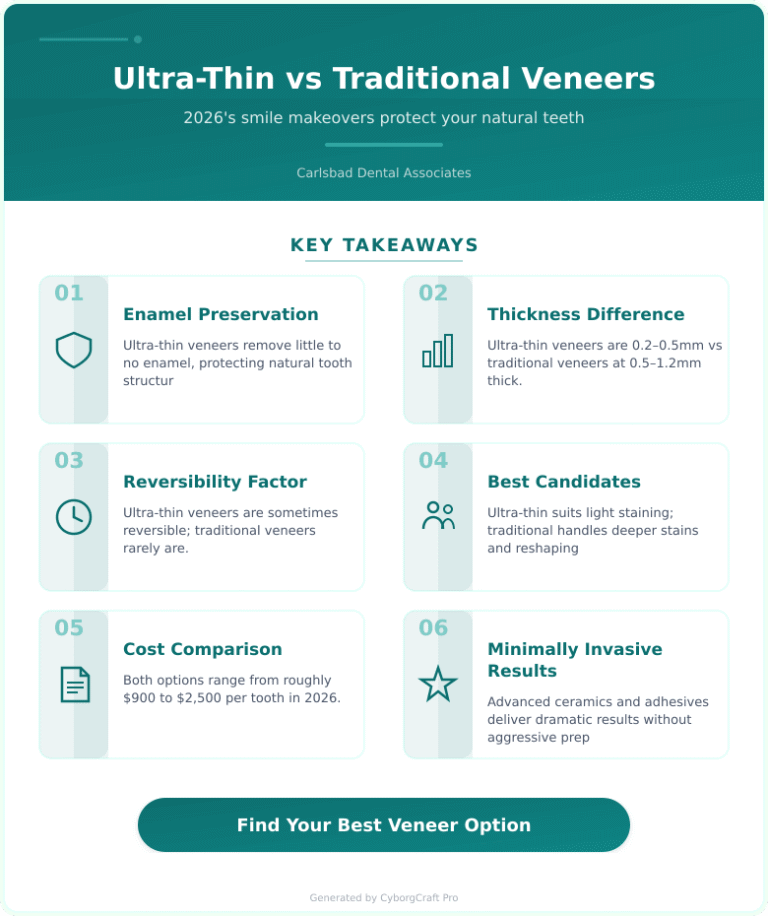
Ultra-thin veneers are porcelain shells between 0.2 and 0.5 millimeters thick that bond to the front surface of teeth to improve color, shape, and symmetry. Because they require little to no enamel removal, they preserve more of your natural tooth structure than traditional veneers while still delivering dramatic cosmetic results.
This guide focuses specifically on helping adults in Carlsbad and surrounding communities understand the real difference between ultra-thin and traditional veneers so they can make a confident, informed decision about their smile.
Ultra-Thin Veneer Definition: A minimally invasive porcelain facing, typically 0.2-0.5 mm thick, bonded to the enamel surface with minimal or no tooth reduction required before placement.
The most common concern patients bring up is this: “I don’t want my teeth shaved down.” That fear is legitimate. Traditional veneers have historically required grinding away a noticeable layer of enamel to make room for the shell. Once that enamel is gone, it doesn’t come back. Ultra-thin veneers change that equation in a meaningful way, offering a more conservative path to cosmetic improvement.
What Makes Ultra-Thin Veneers Different
The thickness difference sounds small on paper. But 0.2 mm versus 1.0 mm is the difference between preserving nearly all of your enamel and permanently altering your tooth structure.
No-prep or minimal-prep veneers (terms used to describe ultra-thin options) rely on advanced ceramic materials and bonding adhesives to stay in place without needing the tooth dramatically roughened first. Your dentist can describe the specific ultra-thin veneer options that may be appropriate for your case.
Enamel does not regenerate once removed, which is a well-established principle in dentistry and a key reason why preservation is a priority in modern cosmetic planning. That’s why many patients asking about smile makeovers in 2026 are specifically asking whether they’re a candidate for the no-prep route.
Thinking about whether this fits your situation? Contact us and we’ll walk you through your options with no pressure.
Ultra-Thin Veneers vs Traditional Veneers: Which Approach Works?
Where ultra-thin veneers succeed: Minimal invasiveness, reversibility in some cases, faster preparation appointments, and preserved enamel. They work especially well for teeth that are structurally sound and need only color or minor shape corrections.
Where ultra-thin veneers fall short: They can’t correct severe misalignment, significant gaps, or dark intrinsic staining (like tetracycline discoloration). On teeth that are already slightly bulky, adding an ultra-thin shell without any prep can make the tooth look thicker than natural.
Where traditional veneers succeed: They handle a wider range of cosmetic issues, including moderate crowding, deeper stains, and teeth that need more dramatic reshaping. The prep process gives the dentist more control over the final contour.
Where traditional veneers fall short: Removing 0.5-1.0 mm of enamel is permanent. If the veneer ever fails, the underlying tooth will always need some form of coverage. They typically require temporaries between appointments and more chair time overall.
The verdict: If your teeth are healthy, lightly discolored, and close to the shape you want, ultra-thin veneers are worth a serious look. If you need significant reshaping or stain correction that goes beyond surface-level, traditional veneers will likely deliver better long-term results. A proper clinical exam is the only way to know for certain which path fits your mouth.
| Feature | Ultra-Thin Veneers | Traditional Veneers |
|---|---|---|
| Thickness | 0.2 – 0.5 mm | 0.5 – 1.2 mm |
| Enamel Removal | None to minimal | 0.5 – 1.0 mm removed |
| Reversibility | Sometimes possible | Rarely reversible |
| Best For | Light staining, minor shape issues | Deeper stains, reshaping needs |
| Typical Industry Cost (2026) | $900 – $2,000 per tooth | $925 – $2,500 per tooth |
| Longevity | 10 – 20 years with care | 10 – 20 years with care |
Cost ranges reflect general industry averages and are not the specific fees of any individual dental office. Always request a personalized treatment estimate.
Your Ultra-Thin Veneer Decision Checklist
- Step 1 – Confirm enamel health: Ultra-thin veneers bond best to intact, healthy enamel. Your dentist will check for decay, gum disease, or existing restorations that could affect bonding.
- Step 2 – Define your goal: Whitening alone? Invisalign or composite bonding may cost less. Veneers are best when you’re correcting shape and color together.
- Step 3 – Review digital mockup options: Ask your dental office whether digital smile design tools are available so you can preview results before any preparation begins.
- Step 4 – Discuss material choices: Several advanced ceramic materials are used for ultra-thin veneers today. Ask your dentist which material they recommend and why.
- Step 5 – Confirm aftercare requirements: Veneers require avoiding biting hard objects, wearing a nightguard if you grind, and keeping up with professional cleanings.
- Ultra-thin veneers are not a solution for teeth with active decay or untreated gum disease
- Teeth whitening should happen before veneer placement if you want the surrounding teeth to match
- Porcelain veneers do not respond to whitening treatments after bonding
- Insurance typically classifies veneers as cosmetic and does not cover them
According to the National Institute of Dental and Craniofacial Research, enamel forms before adulthood and cannot regenerate, which is why minimally invasive techniques are gaining significant attention from both patients and clinicians heading into 2027.
What the Process Actually Looks Like
Phase 1: Consultation and Planning (1-2 Appointments)
Your dentist evaluates your teeth, takes digital photos or scans, and discusses whether ultra-thin veneers fit your bite and enamel thickness. Most patients leave this appointment with a clear sense of which option suits them.
Key actions during this phase:
- Full oral health exam and X-rays
- Digital smile preview if available
- Discussion of material options and shade selection
Phase 2: Preparation and Impression (1 Appointment)
For no-prep ultra-thin veneers, this step involves cleaning and etching the tooth surface only. For minimal-prep cases, a very light reduction is made. Impressions or digital scans go to the dental lab.
Phase 3: Bonding (1 Appointment)
The finished veneers are tried on, adjusted for fit and shade, then permanently bonded with light-cured adhesive. Most patients leave this appointment with their full new smile in place.
Want to see how this process fits your schedule? Contact us to ask about appointment availability at Carlsbad Dental Associates.
Key Takeaways for Carlsbad Residents in 2026
- Enamel preservation matters – ultra-thin options protect the tooth structure you were born with
- Not everyone qualifies – a clinical exam determines whether your teeth are candidates
- Both veneer types last 10-20 years – longevity depends more on home care and bite habits than the type chosen
- Cost is comparable – ultra-thin veneers don’t carry a dramatic price premium over traditional options in 2026
- Cosmetic timing matters – complete any whitening or orthodontic work before veneer placement
Patients We See in Carlsbad and Nearby Communities
Carlsbad Dental Associates welcomes patients from Carlsbad, Oceanside, Vista, San Marcos, Encinitas, La Costa, Rancho Santa Fe, and the greater San Diego North County area. If you’ve been thinking about a smile refresh and want straight answers about whether ultra-thin veneers make sense for you, our team is here to help. Explore our services for a full picture of what we offer.
Frequently Asked Questions
How much do ultra-thin veneers cost in California in 2026?
Ultra-thin veneers in California typically range from $900 to $2,000 per tooth based on general market averages. Final cost depends on the material used, the number of teeth treated, and your specific dental needs. Always get a written estimate before committing to treatment.
Are ultra-thin veneers covered by dental insurance?
Most dental insurance plans classify veneers as a cosmetic procedure and do not provide coverage. Some plans may contribute if there’s a functional component to the treatment, but patients should verify coverage directly with their provider before starting.
Do ultra-thin veneers hurt?
Most patients report little to no discomfort during ultra-thin veneer placement because minimal tooth reduction is involved. Some mild sensitivity is possible after bonding, but it typically resolves within a few days.
How long do ultra-thin veneers last?
With proper care, ultra-thin veneers can last 10 to 20 years. Avoiding hard foods, wearing a nightguard if you grind your teeth, and keeping up with regular cleanings all extend veneer life significantly.
Can ultra-thin veneers fix crooked teeth?
Ultra-thin veneers can improve the appearance of mildly uneven teeth but are not a substitute for orthodontic treatment. Significant crowding or bite issues are better addressed with Invisalign or braces before veneer placement is considered.
What is the difference between Lumineers and traditional porcelain veneers?
Lumineers are a branded ultra-thin veneer about 0.2 mm thick that typically requires no enamel removal, while traditional porcelain veneers require 0.5-1.0 mm of enamel prep. The right choice depends on your specific tooth shape, stain depth, and cosmetic goals.
Your Next Step Toward a Better Smile
The gap between wanting a new smile and actually getting one usually comes down to not knowing where to start. Ultra-thin veneers have made the process faster and less invasive than most people expect, especially with the bonding and imaging technology available in 2026.
If you’re in the Carlsbad area and ready to find out whether your teeth are candidates for minimal-prep veneers, reach out to the team at Carlsbad Dental Associates, located at 5814 Van Allen Way #220, Carlsbad, CA 92008. Contact us today to schedule a consultation and get a clear, honest look at your options before committing to anything.
This content is for educational purposes only and is not a substitute for professional dental advice. Please consult a licensed dentist for guidance specific to your oral health.